How to layer luxury necklaces for a sophisticated look begins with restraint, not excess. A polished arrangement should feel collected, rather than assembled in a hurry. McKinsey & Company’s jewelry research projects annual fine-jewelry growth of approximately 6% to 8% through 2028. That momentum reflects stronger interest in meaningful, wearable pieces. Bain & Company and Altagamma also reported that personal luxury goods reached an estimated €1.48 trillion in 2024. These figures suggest a clear shift toward investment pieces with lasting emotional value.
Katerina Perez, an established jewelry journalist and industry specialist, describes the principle simply: “Layering is about creating harmony between different pieces.” Her observation gives this trend practical direction. Begin with a fine 16-inch chain, then add a pendant at 18 inches. Finish with a longer, lighter strand near the collarbone. The spacing should remain visible. Otherwise, the necklaces may merge into one bright, confusing line.
Material matters, too. Pair polished gold with subtle diamonds, textured links, or a single pearl. Keep one necklace visually dominant. Let the others support it. A low neckline provides breathing room, while a silk blouse creates softer contrast. I sometimes prefer one imperfect detail, such as a slightly uneven pendant position. It can make the styling feel human, not showroom-perfect. Still, balance requires reflection. Too many logos, oversized charms, or competing gemstones can weaken the sophisticated effect. Luxury is not measured by quantity. It is expressed through proportion, craftsmanship, and deliberate choice.
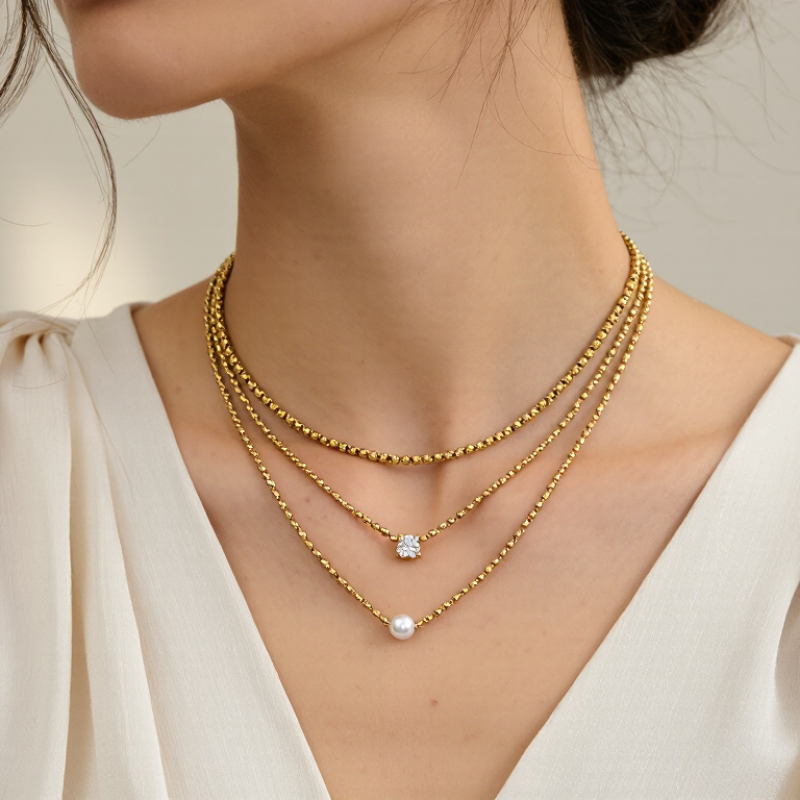
Before choosing necklaces, define the visual goal you want to create. Do you want a quiet, polished line or a noticeable statement? Your answer determines every later choice. A sophisticated layered look usually needs one clear focal point. This might be a small pendant resting near the collarbone. The remaining chains should support it, not compete with it.
Start with the neckline and the space around it. A low neckline can hold three distinct lengths, such as 16, 18, and 22 inches. A high neckline may look cleaner with two shorter layers. Keep one visible gap between each necklace. Without breathing room, the arrangement can appear tangled rather than intentional. I often place the longest piece first, then add shorter chains gradually. This makes proportion easier to judge in a mirror.
Metal color also shapes the visual message. One finish can look refined and architectural. Mixed finishes can add warmth, but they need a repeated detail, such as matching pendant shapes. Consider the necklace texture too. A delicate chain beside a slightly heavier one creates useful contrast. I sometimes remove a piece after seeing the full outfit. More jewelry is not always more luxurious. Lighting, movement, and fabric can change the result, so test the layers while standing and walking. My first arrangement is rarely perfect. A small imbalance can reveal that the visual goal was unclear.
| Visual Goal | Recommended Necklace Structure | Typical Lengths | Layer Spacing | Best Pendant Scale | Neckline & Occasion | Refined Styling Direction |
|---|---|---|---|---|---|---|
| Minimalist polish | Two delicate chains with one subtle pendant | 40–45 cm 16–18 in |
3–5 cm 1–2 in |
Small: approximately 5–12 mm | Open collar, crew neck, office or daytime dressing | Keep both chains fine and use a restrained metal palette for a clean, sophisticated finish. |
| Elegant definition | Short chain, medium-length pendant necklace, and a longer fine chain | 40 cm, 45 cm & 50–55 cm 16 in, 18 in & 20–22 in |
4–7 cm 1.5–3 in |
Small to medium: approximately 8–20 mm | V-neck, square neck, dinners and refined daytime events | Place the pendant on the middle layer so the eye moves naturally from the neckline toward the center of the outfit. |
| Modern statement | One close-fitting chain, one textured chain, and one longer pendant or link style | 40–45 cm, 50–55 cm & 60–75 cm 16–18 in, 20–22 in & 24–30 in |
5–10 cm 2–4 in |
Medium: approximately 15–30 mm | Plunging neckline, simple knitwear, evening or fashion-led looks | Balance visual weight by pairing one bold element with two lighter layers rather than stacking three heavy pieces. |
| Soft romantic layering | Fine chain, pearl-like strand, and a small drop pendant | 40–45 cm, 45–50 cm & 55–60 cm 16–18 in, 18–20 in & 22–24 in |
3–6 cm 1–2.5 in |
Small to medium: approximately 6–18 mm | Scoop neck, sweetheart neck, weddings and special occasions | Vary texture and silhouette while maintaining a delicate overall scale to preserve an airy appearance. |
| Quiet luxury | Two or three finely proportioned chains with minimal visible embellishment | 40 cm, 45 cm & 50–55 cm 16 in, 18 in & 20–22 in |
4–6 cm 1.5–2.5 in |
Small: approximately 3–10 mm | Button-down shirt, tailored blazer, business or travel dressing | Prioritize consistent finishing, subtle texture, and controlled proportions instead of excessive sparkle. |
| Layered focal point | Two short chains framing one distinctive central pendant | 40–45 cm, 45–50 cm & 55–65 cm 16–18 in, 18–20 in & 22–26 in |
5–8 cm 2–3 in |
Medium to large: approximately 20–40 mm | Simple high neckline, monochrome outfits, gallery or evening settings | Let the central pendant remain the visual anchor; keep the surrounding chains lighter and less ornate. |
| Balanced mixed-metal look | Two layers in the dominant metal with one fine contrasting-metal accent | 40–45 cm, 45–50 cm & 55–60 cm 16–18 in, 18–20 in & 22–24 in |
3–6 cm 1–2.5 in |
Small: approximately 5–15 mm | Neutral necklines, contemporary workwear, daytime-to-evening dressing | Repeat the accent metal once elsewhere, such as in earrings or a watch, to make the contrast appear intentional. |
| Long, elongating effect | Short neckline chain paired with a long pendant necklace | 40–45 cm & 60–90 cm 16–18 in & 24–36 in |
15–30 cm 6–12 in |
Small pendant on the short layer; medium pendant on the long layer | High neck, turtleneck, layered knitwear and evening silhouettes | A longer vertical line can visually lengthen the torso, especially when the clothing beneath is a single, uninterrupted color. |
Start with a delicate chain resting near the collarbone. A 16–18-inch length creates a quiet foundation. Keep it comfortable.
Three layers often create clear structure without crowding. Use a short chain, a medium pendant, and one longer statement piece. More can work, but it may look accidental.
Leave roughly two fingers between pendant zones. This reduces tangling and keeps each shape visible. Small gaps matter.
Yes, but repeat one detail across both metals. A small bead or polished clasp can connect gold and silver. I sometimes find mixed metals difficult to balance.
Pair one polished chain with a lightly brushed or hammered surface. Smooth metal reflects cleanly beside a quieter texture. Too much contrast may feel noisy.
Place the strongest pendant or texture on the longest layer. Let it rest near the upper chest or sternum. Keep the neckline clear.
Build the layers on a flat surface before wearing them. Then check the necklace while standing, sitting, walking, and turning. Mirrors can mislead.
Remove one necklace before adjusting everything else. A small extender can change the drop by a few centimeters. Less works.
Match necklace weight with your neckline and skin comfort. Check clasp positions because they may twist during movement. Test the arrangement for at least half an hour.
Not necessarily. Slightly uneven lengths can feel personal when they appear intentional. Forgotten-looking gaps need correction.
How to layer luxury necklaces for a sophisticated look begins with defining the visual impression you want to create. Decide whether your style should feel delicate, polished, modern, or bold, then choose necklace lengths that leave balanced space between each layer. A shorter chain can establish a refined foundation, while medium and longer pieces add dimension without making the arrangement appear crowded.
For a cohesive result, combine metals, textures, and pendants with intention rather than mixing details randomly. Begin with subtle, minimal pieces and gradually introduce a distinctive statement necklace as the focal point. Consider how each pendant sits in relation to the others, and adjust the spacing, weight, and placement until the composition feels natural. Finally, check that the necklaces remain comfortable, move freely, and complement your neckline. Thoughtful coordination transforms multiple pieces into an elegant, sophisticated arrangement that looks luxurious without appearing excessive.

 Locke Jewelry